







Staining a floor darker: what it can and cannot hide
Stain compresses contrast, so marks stop standing out. It does not remove them, and on some timbers it blotches.
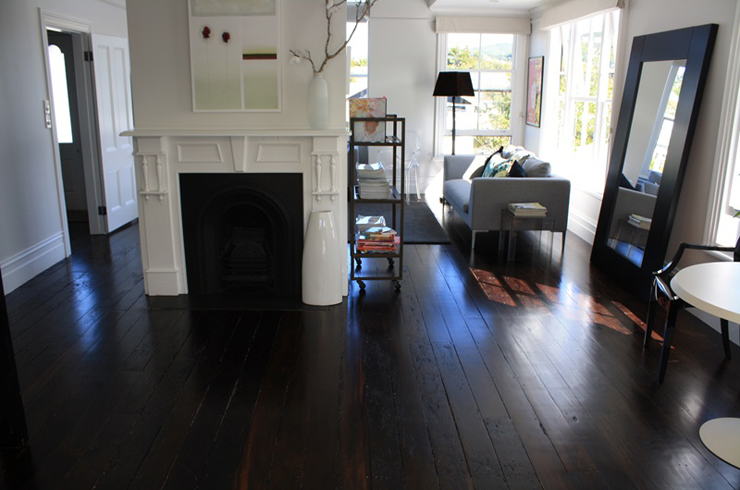
On an old floor with black nail rings, patchy repairs and boards from three different sources, a mid to dark stain is often the most effective thing we can do. It works by reducing contrast rather than by covering anything.
What it hides well
Marks that are darker than the timber stop standing out once the timber around them goes dark too. Iron staining around nails, old water marks and the ghost of a border that was polished decades ago all become much less noticeable.
Mismatched boards blend. If a room has had repairs over the years in whatever timber was to hand, a stain pulls the range together.
What it does not hide
Anything lighter than the stain still reads. A patch of new timber let into an old floor will take stain differently from the aged boards around it and often comes up lighter, so the repair can end up more visible after staining rather than less.
Texture is unaffected. Dents, gouges and cupping are shape rather than colour, and a dark floor arguably shows them more because the reflected light picks out the profile.
Smell from pet contamination is unaffected, and so is the contamination itself.
Blotching on native timber
Rimu is soft and its absorbency varies across a board. Apply stain directly and it drinks unevenly, giving a mottled result that looks like a mistake rather than a finish.
A conditioner or wash coat applied first evens out absorbency so the stain sits consistently. Skipping that step is the most common cause of a stained rimu floor looking wrong, and it is not correctable afterwards without sanding back to bare timber.
Matai behaves better but is harder and takes stain lighter than rimu, so a house with both timbers will show a colour difference across the doorway. Trying to force a match between the two usually reads worse than letting them differ.
Sanding grit changes the colour
Timber sanded to a finer grit takes less stain, because the grain closes up. The same product on the same floor comes out noticeably lighter at 150 grit than at 100.
That means the sample has to be prepared the same way the floor will be. A test panel sanded by hand to a different finish than the machine will produce tells you nothing useful.
Always sample on your own floor
Colour cards are close to useless for floor stain. The result depends on your timber, its age, its absorbency and the grit it was sanded to.
We prepare test areas on your own boards in the room, usually two or three colours side by side, and leave them for you to look at in daylight and at night. It is the only reliable way to choose, and it is worth the day it adds to the job.
Look at the samples with the curtains open, with the lights on, and from standing height rather than crouched over them. A colour that looks right from 300mm can be much darker than you wanted across a whole room.