







Why the edges and corners take longer than the middle
The drum sander cannot reach the last 100mm. What happens in that band decides whether the floor looks professionally done.
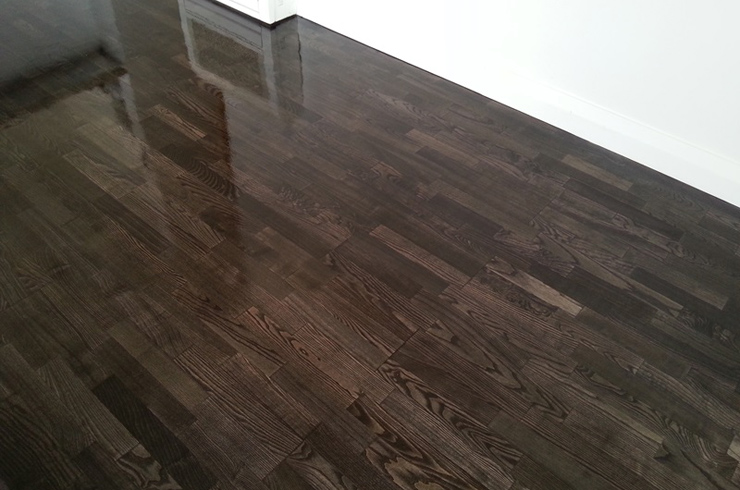
The open middle of a room is the fast part of a sand. A drum machine covers it in passes, and on a straightforward lounge that work is done in a morning. The perimeter is where the hours go.
The 100mm the machine cannot reach
A drum sander has a housing around the drum, so the abrasive stops roughly 100mm short of any wall. That leaves a band right around the room, plus the returns in a bay window, the strip in front of a hearth, the run under a doorway and the awkward space where a wall meets at anything other than a right angle.
All of that gets done with an edger, a smaller machine held at an angle against the floor, and the corners come out by hand with a scraper and a cabinet blade.
Why the join is the hard part
The edger cuts in a rotary pattern. The drum cuts in a straight line with the grain. Where the two overlap, you get a boundary that will show under raking light unless the operator blends it properly, working the edger back into the drum-sanded area and then hand-finishing the transition.
A floor where nobody bothered to blend shows a visible halo around the whole room once the sun comes through at a low angle in the afternoon. It is the single most common giveaway of a rushed job, and it is very hard to correct afterwards without redoing the entire floor.
Corners are hand work
No powered machine reaches into the internal corner of a room, so somebody kneels down with a scraper and takes the finish off by hand, then works through the same grit sequence with hand blocks. In a room with a fireplace, a bay and two doorways, there might be a dozen of these.
This is slow, and it is why a room full of nooks costs more per square metre than a plain rectangle of the same area. When Paul measures your house he is counting corners and doorways as much as floor area.
What this means for your quote
Two rooms of identical size can be priced quite differently. A square bedroom with one door has very little perimeter work relative to its area. A villa lounge with a bay window, a hearth, two doorways and a built-in cabinet has a great deal, and the sanding takes noticeably longer even though the square metre figure is the same.
If you are comparing quotes and one is markedly cheaper, ask how the edges and corners are handled and how the transition gets blended. The answer will tell you where the money went.
Checking the work
Look along the perimeter in daylight before the first coat goes on, with your eye low and the light coming across the floor rather than from behind you. You are looking for a change in texture or a swirl pattern in the band nearest the skirting. Raise it then, while it is still fixable.