





Why stairs cost what they do
Every tread is edge work and corner work, done by hand, in a space you cannot get a machine into.
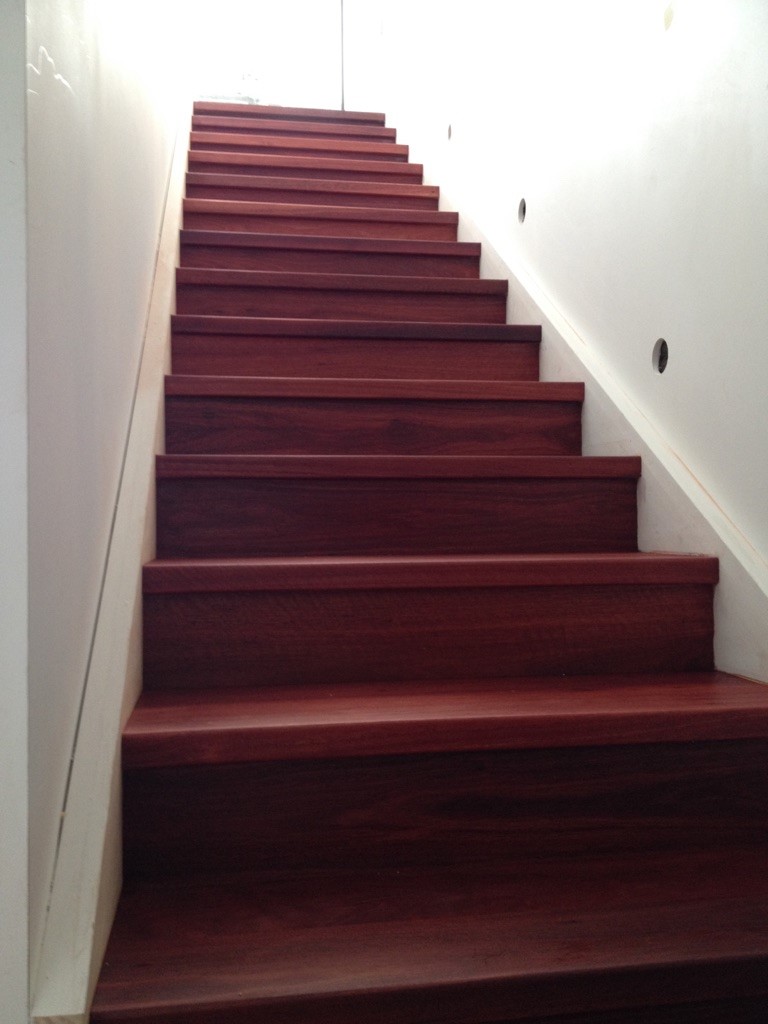
Stairs get quoted separately from floors, and per square metre they cost several times as much. The reason is that almost none of the work can be done by machine.
No machine fits
A flight of stairs has no open area. Each tread is a narrow strip with a nosing at the front, a riser behind it, and a stringer or a balustrade at one or both ends.
A drum sander cannot be used at all. An edger can be used on part of a tread by an operator who knows what they are doing, and the rest comes off with hand blocks, a detail sander and a scraper.
Everything on a staircase is the equivalent of the perimeter work on a floor, which is the slow part of any sand.
The nosing
The rounded front edge of each tread is the most worn part of a staircase and the hardest to sand. Take too much off and the profile flattens and the tread looks wrong. Take too little and the old finish stays in the curve.
It is done by hand, carefully, one tread at a time.
Balustrades and spindles
Where a balustrade sits on the treads, every spindle is an obstruction to work around and a corner to hand finish. A staircase with turned spindles at close centres can double the labour compared with the same flight with an open side or a glass balustrade.
Removing a balustrade to sand underneath is sometimes worth doing and is a carpentry job in its own right.
Coating them takes longer too
You cannot walk on a freshly coated staircase, and unlike a floor, you often cannot avoid it either if it is the only route between levels.
The usual answer is coating alternate treads so there is a route up and down, letting those cure, then doing the remainder. That turns a one day coating job into two or three, and it needs everyone in the house to understand which treads they can stand on.
Where a house has a second staircase or the upper level can be left alone for a few days, it goes faster.
What you get for it
A well finished timber staircase is the most visible piece of joinery in most houses and it takes a great deal of wear. Getting it right is worth doing properly.
If the budget is tight, doing the floors now and the stairs later is a reasonable staging, and it does not compromise either. Tell Paul at quote stage and he will price them separately so you can see the two numbers.
Carpeted stairs
If your stairs are currently carpeted and you are thinking of exposing them, lift a corner at the top first. Treads under carpet are sometimes a rough grade timber never intended to be seen, particularly in a mid century house, and no amount of sanding makes them into a feature.