
Wax polish, pre-1960
- Where
- Thorndon, Northland, Wadestown, Kelburn villas
- First cut
- Gums the belt within metres. More abrasive, slower going


Ring Paul. He will tell you straight, no charge for the quote.
Get My Free Quote“They really need to change their name to 5 star”Theo Modlik, Parapine ITM




We supply and install from New Zealand’s leading timber suppliers.
Based at 16 Gear Street, Petone. We work from Island Bay to Otaki. Not sure if we cover you? Call 0800 005 287.
“The pricing is fair and the workmanship has been immaculate.”Theo Modlik
“The floors are still impeccable.”Linda and Paul, KhandallahRead all 8 reviews
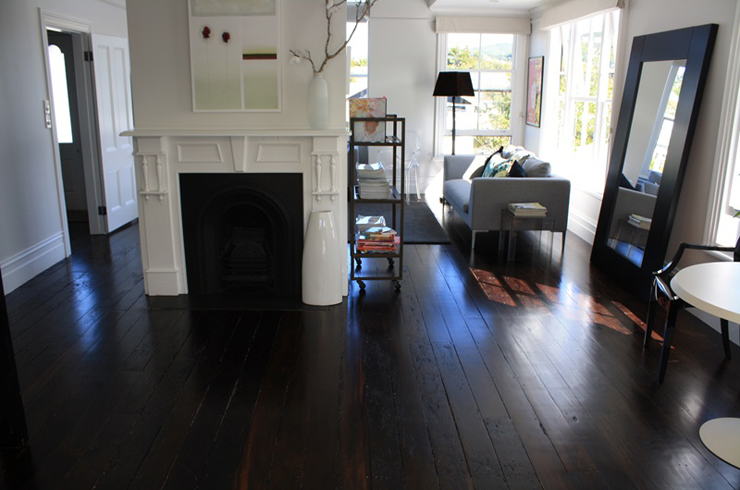
Grey boards, a tack hole every 150mm and eighty years of wax polish in the grain. We cut through all of it and coat the timber underneath, working out of a Petone workshop 20 to 30 minutes from your street.
Ring Paul or send him an email and he will tell you whether it is a sand or a recoat. No charge for the quote.

Around the edge of the room there is a hole every 150mm where the tacks went in, a dark stripe where the gripper sat, and staples standing proud from the foam underlay. Down the middle the boards are the colour of weak tea.
Run a fingernail across a Thorndon or Northland floor built before 1960 and it drags, because somebody kept that timber under wax polish for decades and the wax is still in the top half millimetre. None of that rules out a sand. It changes what day one costs.
Wellington City put down tongue and groove rimu almost everywhere between 1900 and 1940, with matai in halls and kitchens where traffic was heaviest. Those boards were finished with shellac and wax long before polyurethane reached New Zealand, and wax loads an abrasive belt within a few square metres. The belt stops cutting and starts polishing, so the operator changes it and carries on. On a waxed Karori bungalow the first coarse pass can burn more abrasive than the three finer passes after it, and that sits in the quote rather than turning up at the end.
Nail heads get punched below the surface first, because a proud head tears a belt and rips a line the length of the room. A coarse grit cuts the floor flat, then we work up through the sequence with an edger and a corner machine following the drum around skirtings, bay returns and hearth. The coating is Synteko Nova Best XC, a two-component water-based polyurethane in matte, extra natural matte or satin, low odour, which matters in a villa where you are sleeping down the hall.
Piles settle. On a Wadestown or Aro Valley section cut into the slope the floor rolls, and a drum sander run across it takes the crowns to nothing while never reaching the hollows. Packing the subfloor first leaves a hundred-year-old board the thickness it needs for the next owner. A dropped bearer or a rotted pile goes on the quote as a floor repair.
Room count comes first, because a six-room villa has six sets of edges and edge work is hand work. Old finish comes second, since a waxed floor burns abrasive. Access comes third, and nobody budgets for it: forty council steps between road and door, a street too narrow for a loaded truck, a Te Aro body corporate wanting a lift booking.
The machines take the great majority of it at source. In a villa with gaps between boards, some comes back up from under the house.
Water-based Synteko is low odour and gone in about a day. If anyone has asthma, say so at quote stage, not on day three.
Grey is oxidised surface, roughly half a millimetre deep. Borer through the tongues or a floor sanded down to the nails is a different conversation, and Paul will have it with you straight.
You can arrange an asbestos test yourself, or we can do it for $115 + GST per test.
We have recently [completed] our renovation and chose 4Star Flooring to lay a Matai floor in our new extension, plus sand and coat our new and existing Matai floorboards throughout the house. Their work was impressive and the manager, Paul, was readily available to talk us through the process and provide the necessary advice. He suggested the floors would look at their very best with the Rona application. We have had many compliments about the standard of workmanship and, although it has been more than 12 months since 4Star did the work for us, the floors are still impeccable. We would highly recommend 4Star Flooring and especially the Rona process.
Seven more on the reviews page.
Yes. Wax sits in the top half millimetre of timber and the first coarse pass takes it off with the grey. The cost is abrasive rather than difficulty, so a waxed Kelburn floor burns more consumables on day one than one coated in polyurethane in 1985.
No, and a sander used that way does damage. A floor that rolls because piles have settled needs the subfloor packed first. Flattening it with the drum takes far more than one to two millimetres off the high boards, which is thickness a Karori villa cannot spare.
Hours, not a mystery fee. Machines, a vacuum unit and 40 litres of coating go up by hand where the truck cannot get close, twice a day for a week. Tell Paul the step count and whether the street can be parked on, and those hours sit in the fixed price rather than arriving as a variation.
No. Heritage rules in Thorndon and Mount Victoria govern the outside of the house, and your floorboards are yours. The constraint is the timber, since original native rimu and matai cannot be bought back, so we decline a fourth sand on a floor that has had three.
Four to five working days for a typical villa floor, two noisy and three coating days. Stairs, a stain colour or a July booking add one. Rooms beyond a wet hallway are unreachable, which is why most Wellington families arrange two nights elsewhere.
Fold the carpet back in the least visible room and have a look, then ring Paul with your suburb. He will tell you whether it is matai or rimu, whether it needs a full sand or a recoat instead, and what it costs.
City work books out fastest from October to March, so start early against a settlement date.